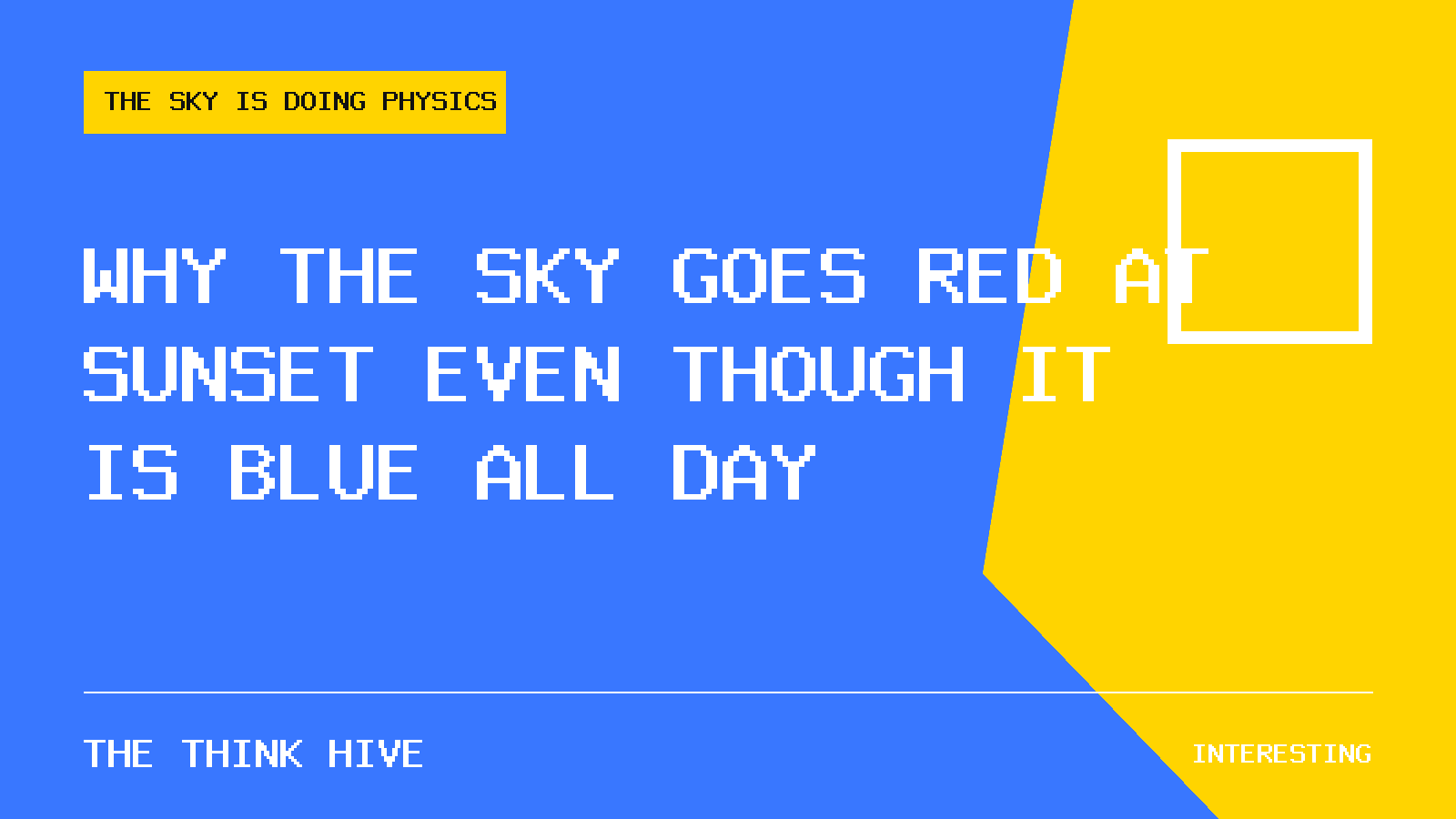
Why the Sky Goes Red at Sunset Even Though It Is Blue All Day
The Sun has not changed colour. The light has simply taken a much longer route through the atmosphere.
Blue light gets scattered around the sky more easily.
Sunlight looks white, but it contains the visible colours of the spectrum. When that light enters Earth’s atmosphere, molecules in the air scatter some wavelengths more strongly than others.
Shorter visible wavelengths, especially blue and violet, are scattered more efficiently than longer red wavelengths. Our eyes are more sensitive to blue than violet, and some violet is absorbed higher in the atmosphere, so the sky usually looks blue to us.
Sunset makes sunlight travel through much more air.
When the Sun is high overhead, its light takes a relatively direct route through the atmosphere. Near the horizon, that route becomes much longer. The light passes through more air before it reaches your eyes.
By the time that low-angle sunlight gets to you, much of the blue light has been scattered away from the direct beam. The colours left travelling more directly towards you lean towards yellow, orange and red.
Particles, clouds and humidity can change the show.
Aerosols, dust, smoke, cloud layers and moisture can change how light is scattered. That is why one evening can look like a soft peach gradient while another looks as if somebody has turned the saturation slider all the way up.
A dramatic red sunset does not, by itself, tell you one simple thing about air quality. The colour comes from several interacting conditions, so the sensible answer is usually more complicated than “red means pollution.”
That is the whole trick: the same sunlight, filtered through a different amount of atmosphere.
Sunsets are basically a daily physics demo.
The next time the horizon turns orange, the interesting part is not that the Sun became red. It is that the atmosphere edited the light before it reached you.
Evergreen science explainer based on the NASA sources listed below.
Where this came from.
- NASA Space Place ↗ Explanation of atmospheric scattering and red sunsets
- NASA Science ↗ Background on light scattering